Pool Chemical Calculator Guide: The 5 Numbers That Matter
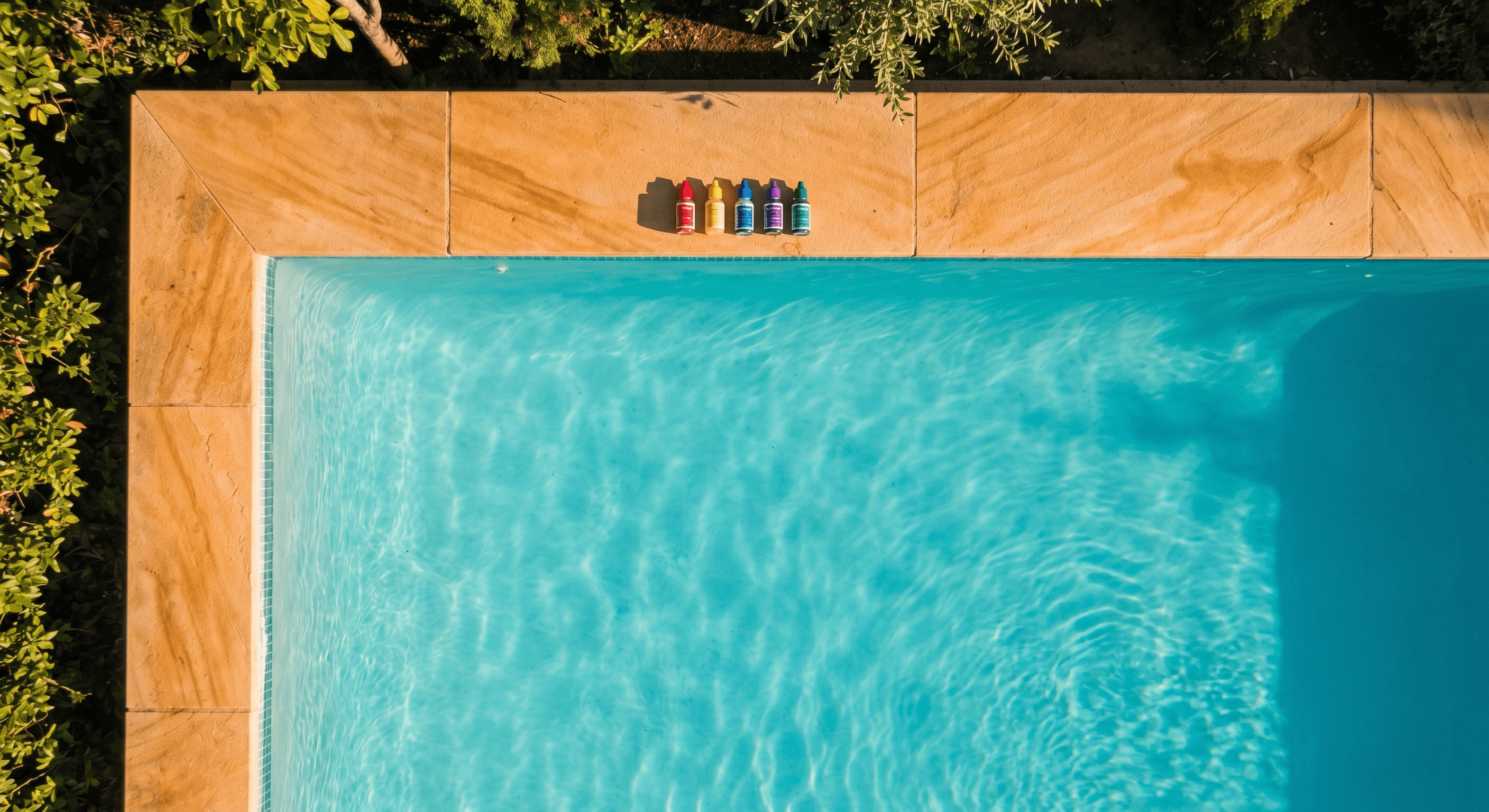
Pool chemistry can feel overwhelming. There are dozens of chemicals on the pool store shelf, conflicting advice online, and test kits that measure parameters you may have never heard of. But here is the truth: pool chemistry comes down to 5 numbers. Understand these 5 parameters, how they interact, and what to do when they drift — and you have pool chemistry figured out.
This guide covers everything a pool owner needs to know about water chemistry, from the basics of each parameter to the CYA-chlorine relationship that most pool stores get wrong.
The 5 Key Pool Chemistry Parameters
Every pool chemical calculator works with the same core readings. Here is what each one means, why it matters, and what your target should be.
1. Free Chlorine (FC)
Free chlorine is the active, available chlorine in your water — the chlorine that is actually killing bacteria, viruses, and algae. It is the single most important number in pool chemistry.
Ideal range: This depends on your CYA level (see the table below). The generic "1–3 ppm" recommendation is only valid when CYA is 0. Most pools have CYA of 30–80, which means you need FC of 3–8 ppm.
What raises it: Liquid chlorine (sodium hypochlorite), bleach, cal-hypo, dichlor, trichlor tablets, or a salt chlorine generator.
What lowers it: Sunlight (UV), bather load, organic debris, and time. CYA slows UV degradation but also reduces chlorine effectiveness at any given FC level.
Not all chlorine is "free." When chlorine combines with nitrogen compounds (sweat, urine, sunscreen), it forms combined chlorine (chloramines) — the cause of the "chlorine smell" at pools. Total Chlorine = Free Chlorine + Combined Chlorine. If TC is more than 0.5 ppm above FC, you need to shock.
2. pH
pH measures how acidic or basic your water is on a scale of 0–14. Pool water should be slightly basic.
Ideal range: 7.4–7.6
Why it matters: pH directly affects chlorine effectiveness. At pH 7.2, about 63% of your free chlorine is in the active form (hypochlorous acid). At pH 8.0, only about 21% is active. High pH means your chlorine works much harder for the same sanitation result.
pH also affects swimmer comfort. Water below 7.2 irritates eyes and skin and corrodes metal equipment. Water above 7.8 causes cloudy water, scale formation, and dramatically reduced chlorine potency. For detailed dosing instructions on adjusting pH, see the pH balance guide.
What raises pH: Aeration (waterfalls, spillovers, SWG operation), soda ash, borax, and the natural tendency of pool water to drift upward.
What lowers pH: Muriatic acid and dry acid (sodium bisulfate). Adding liquid chlorine raises pH slightly; trichlor lowers it slightly.
3. Total Alkalinity (TA)
Total alkalinity is a measure of your water's ability to resist pH changes — its buffering capacity. Think of TA as "pH stability."
Ideal range: 80–120 ppm (60–80 ppm if you use a salt chlorine generator or have a water feature, since aeration drives pH up)
Why it matters: If TA is too low, pH bounces around wildly — you add acid, pH drops too far, you add base, pH spikes. This is called "pH bounce." If TA is too high, pH is very difficult to bring down and tends to drift upward persistently.
What raises TA: Sodium bicarbonate (baking soda). This is the only common chemical that raises TA significantly without spiking pH. The alkalinity guide covers exact dosages and the acid-then-aerate technique for lowering TA.
What lowers TA: Muriatic acid lowers both TA and pH. To lower TA without crashing pH, add acid to lower pH to about 7.0–7.2, then aerate (run a waterfall, point a return up) to raise pH without raising TA. Repeat until TA is in range.
4. Calcium Hardness (CH)
Calcium hardness measures the dissolved calcium in your water.
Ideal range: 200–400 ppm (250–350 for plaster pools, 150–250 for vinyl and fiberglass)
Why it matters: Water that is low in calcium is "aggressive" — it seeks calcium by etching plaster surfaces, corroding metal heat exchangers, and degrading grout. Water that is too high in calcium deposits scale on tile lines, inside heaters, and on salt cells.
The Langelier Saturation Index (LSI) combines pH, temperature, TA, CH, and TDS to determine whether your water is corrosive, scaling, or balanced. Most pool owners do not need to calculate LSI manually, but understanding that calcium is part of the balance equation is important.
What raises CH: Calcium chloride. Also, cal-hypo shock adds calcium (which is why liquid chlorine is preferred for regular shocking).
What lowers CH: There is no chemical to remove calcium. The only way to lower CH is partial drain and refill with lower-calcium source water. In hard-water areas, consider pre-filtering fill water.
5. Cyanuric Acid (CYA)
Cyanuric acid — also called stabilizer or conditioner — acts as a UV shield for chlorine. Without CYA, sunlight destroys free chlorine in a matter of hours. With CYA, chlorine lasts much longer in direct sun.
Ideal range: 30–50 ppm (non-saltwater), 60–80 ppm (saltwater pools)
Why it matters: CYA is the most misunderstood chemical in pool care. It protects chlorine from UV, but it also "locks up" a portion of the chlorine, reducing its effectiveness. At CYA 30, about 3% of FC is active. At CYA 100, less than 1% is active. This is why pools with high CYA have algae problems even with "normal" chlorine readings — the chlorine is there, but it is not working.
What raises CYA: Trichlor tablets (the most common cause of high CYA), dichlor shock, and stabilizer added directly. Every trichlor puck adds approximately 0.6 ppm of CYA for every 1 ppm of FC added.
What lowers CYA: Nothing dissolves or neutralizes CYA. The only way to lower it is dilution — partial drain and refill. This is why most experienced pool owners switch from trichlor tablets to liquid chlorine once their CYA reaches target.
The CYA-Chlorine Relationship
This is the most important concept in pool chemistry, and the one that most pool calculators, pool stores, and product labels get wrong.
Your minimum free chlorine level should be based on your CYA level. The standard recommendation of "maintain FC at 1–3 ppm" assumes CYA of 0 — a condition that essentially never exists in an outdoor pool.
Here is the minimum FC target by CYA level, based on the widely accepted guideline of maintaining FC at approximately 7.5% of CYA (with a minimum of 2 ppm):
| CYA (ppm) | Min FC (ppm) | Target FC Range (ppm) | Shock Level (ppm) |
|---|---|---|---|
| 0 | 2 | 2–4 | 10 |
| 20 | 2 | 2–4 | 10 |
| 30 | 2 | 2–5 | 12 |
| 40 | 3 | 3–6 | 16 |
| 50 | 4 | 4–7 | 20 |
| 60 | 5 | 5–8 | 24 |
| 70 | 5 | 5–8 | 28 |
| 80 | 6 | 6–9 | 31 |
| 90 | 7 | 7–10 | 35 |
| 100 | 8 | 8–11 | 39 |
If your CYA is 80 and your FC is 3 ppm, your pool store says you are "in range" — but you are below the minimum effective FC level. Algae can and will grow. Your FC should be at least 6 ppm at CYA 80. For a detailed breakdown, see CYA and Chlorine: Why Your Pool Store Gets It Wrong.
Poolably accounts for this — it uses your actual CYA reading to set your FC target.
How the 5 Parameters Interact
Pool chemistry is not 5 independent numbers. They form a system:
- CYA determines your FC target. Higher CYA means you need more FC. This is the most important interaction.
- pH determines chlorine potency. Even with adequate FC, high pH makes chlorine less effective. Keep pH at 7.4–7.6 for the best balance of sanitation and comfort.
- TA stabilizes pH. Without adequate TA, pH is a moving target. But too-high TA pushes pH up constantly.
- CH protects surfaces. Calcium interacts with pH and TA to determine whether your water etches or scales. High pH + high CH + high TA = scaling. Low pH + low CH + low TA = corrosion.
- Temperature affects everything. Warmer water uses chlorine faster, increases scaling tendency, and makes algae grow more aggressively.
Common Mistakes
Relying on trichlor tablets as your only chlorine source
Trichlor tablets are convenient, but they add CYA with every puck. Over a single season, CYA climbs to 100+ ppm, making your chlorine ineffective. Use trichlor to maintain, but monitor CYA and switch to liquid chlorine when CYA reaches your target.
Trusting pool store test results blindly
Pool store test machines vary in calibration and accuracy. A number of stores test for total chlorine but report it as free chlorine. Always verify critical readings with your own test kit — a good drop-based kit (FAS-DPD for chlorine, titration for TA and CH) is worth the $50–80 investment.
Adding chemicals without knowing your pool volume
Every dosing calculation depends on knowing your pool volume. A 10,000-gallon pool needs half the chemical of a 20,000-gallon pool. If you are guessing your volume, you are guessing your doses. Measure your pool dimensions and use a pool volume calculator.
Adjusting everything at once
Change one parameter at a time. Wait for a full circulation cycle (1–2 hours minimum) before retesting and adjusting the next. The standard sequence is: FC first (if dangerously low), then pH, then TA, then CH, then CYA. Never mix chlorine and acid — this produces toxic chlorine gas.
Using a Pool Chemical Calculator
A pool chemical calculator takes the guesswork out of dosing. Here is how to get the best results:
-
Test your water accurately. Use a reliable test kit — drop-based kits (Taylor K-2006 or TF-100) are the gold standard. Test strips are convenient but less precise.
-
Enter your pool volume. If you do not know your volume, measure length, width, average depth, and use a pool volume calculator. For irregular shapes, break the pool into rectangles and add the volumes.
-
Enter your current readings. FC, pH, TA, CH, CYA at minimum. Some calculators also accept salt, borates, and temperature.
-
Review the treatment plan. A good calculator does not just tell you how much chemical to add — it tells you the order, explains why, and warns about interactions. Poolably generates numbered step-by-step plans with dosing amounts, wait times, and retest instructions.
-
Add chemicals one at a time. Follow the plan sequentially. Run the pump for at least one turnover between additions. Retest before proceeding to the next chemical.
Testing Schedule
Consistency matters more than frequency. Here is a practical schedule:
- 2–3 times per week: FC and pH (these change the fastest)
- Weekly: TA, CH, CYA
- After events: Heavy rain, pool party, adding chemicals, or visible water quality change — test FC and pH immediately
- Monthly (saltwater pools): Salt level, inspect salt cell
Summary
Pool chemistry is 5 numbers. Understand what each one does, keep them in range, and respect how they interact — especially the CYA-chlorine relationship. If your pool has already turned green, follow the step-by-step SLAM guide to clear it. For saltwater pools, see the salt pool calculator guide for SWG-specific chemistry. A pool chemical calculator makes the math easy, but the knowledge in this guide is what turns you from a chemical-guesser into someone who actually understands their pool.
Frequently Asked Questions
Vlad Kuzin
Founder of Poolably. Building the most practical pool chemistry calculator on iOS.